


Sometime in your 40s or 50s, as a woman, the rules of your body change. You might notice that you gain weight more easily. Your regular workouts don’t seem to build strength the way they used to. Your joints feel stiffer, and your overall structure feels more vulnerable.
You aren’t imagining it, and you aren’t doing anything wrong.
You are experiencing a fundamental physiological shift. Research from the National Institutes of Health shows that the menopausal transition is associated with a slowing metabolic rate, changes in body composition, and, most critically, accelerated bone loss. According to the Bone Health & Osteoporosis Foundation (BHOF), a woman can lose up to 20% of her bone density during the 5-7 years following menopause.
But while this shift is natural, a decline in your strength and independence is not inevitable. By applying the right mechanical stress to your body, you can actively biohack your bone density.
This is exactly why the conversation around using a weighted vest for menopause has exploded. But, we know you may be wondering, “Does it actually work?”
Here is a breakdown of the science of menopause and bone density, and exactly how exercising with a weighted vest can be a safe, highly effective strategy to support your long-term skeletal health.
Why Does Menopause Accelerate Bone Loss?
Technically, menopause is the point in time when a woman goes through 12 consecutive months without a menstrual cycle. In reality, this condition does not happen definitely and abruptly, but in stages: perimenopause (40s), menopause (typically early 50s), and postmenopause (60s).
Menopause is more than just the end of menstruation. It is a long period of shifting hormonal levels that produces complex effects on a woman’s body.
The most important player in this shift is the hormone, estrogen, because it plays a central role in maintaining bone health. Estrogen is responsible for regulating the balance between the two types of bone cells:
- Osteoclasts: The cells that clear out and break down old bone tissue.
- Osteoblasts: The cells that build new, dense bone tissue.
Before menopause, estrogen levels are normal. During this period, the processes of bone formation and breakdown remain relatively balanced.
However, as estrogen levels start to decline during perimenopause and menopause, bone breakdown begins to outpace bone formation. The result is accelerated bone loss. This is why menopausal women have a significantly higher risk of osteopenia and osteoporosis, which are conditions characterized by weakened bones and a greater potential for fractures.
Menopause, Muscle Loss, and Bone Health
Estrogen is only part of the story. Menopausal hormonal fluctuations also lead to a decline in lean muscle mass—a condition known as sarcopenia.
Why does muscle matter for bone density?
Muscles create mechanical tension on bones during movement, and that tension signals bones to maintain or increase density. Thus, if lean muscle mass declines, that stimulus weakens.
At the same time, many women naturally drift toward lower-impact exercises, like walking, cycling, or yoga, to protect stiff joints. While these forms of movement are excellent for cardiovascular health and mobility, they may not provide enough mechanical load to meaningfully stimulate bone tissue.
This creates a perfect storm:
- Estrogen levels decline, accelerating bone breakdown.
- Muscle mass goes down, decreasing protective tension on bone.
- Mechanical load on bones lessens, weakening the stimulus bones need to stay strong.
Effective menopause exercise strategies depend on understanding this mechanism.
Mechanical Load and Bone Health: How Bones Get Stronger
Your bones are made up of living cells, and these cells respond to the resistance you put on them. This concept is often explained through Wolff’s Law, the principle that bone adapts to the load placed upon it.
Bones need appropriate, progressive challenges they can adapt to in order to become stronger. In the absence of these challenges, bones become weaker over time.
Weight-bearing and resistance exercises are the top non-pharmaceutical ways to slow bone loss in postmenopausal women. The American College of Sports Medicine recommends progressive resistance training for adults over 40, specifically to preserve musculoskeletal health.
Not all exercises, however, provide the same stimulus. For example:
- Swimming and cycling are excellent for heart health, but are not weight-bearing.
- Walking is weight-bearing, but it may not generate enough force on its own to improve bone density significantly.
This is where the link between a weighted vest and bone health becomes clear. Resistance training and load-bearing exercise provide a stronger mechanical load to bone tissue.
The Solution: Weighted Vests = Extra Mechanical Load on Bones
A weighted vest is a wearable tool that adds external load directly to your torso. Instead of holding weights in your hands, the weighted vest adds the load across your center of mass. This added mechanical load, in turn, compresses and challenges the bones in your spine and hips, the areas most vulnerable to fracture during and after menopause.
When you wear a weighted vest during even simple movements like walking, stair climbing, squats, or lunges, several things happen:
- Ground Reaction Forces (GRF) Increase: The impact of your foot hitting the ground sends a stronger shockwave up your legs.
- Muscles Fire Harder: Your core, glutes, and postural muscles must contract harder to stabilize the extra weight.
- The Skeleton Adapts: The combined stress of gravity and muscle tension signals the osteoblasts to lay down new bone tissue.
Studies examining weighted walking programs in postmenopausal women have shown modest but meaningful preservation of hip bone mineral density compared to walking alone. Preserving hip and spinal bone density is especially impactful because fractures in these areas often require long recovery times and usually lead to loss of independence in older adults.
Research also found that weighted vests improve balance and lower-body strength—both critical for fall prevention.
What the Research Ultimately Shows
The growing body of evidence is clear and consistent. Here’s what we know:
- Menopause accelerates bone loss due to declining estrogen.
- Bone tissue responds to mechanical load.
- Resistance and weight-bearing exercise help slow bone density decline.
- Muscle strength promotes skeletal strength.
- Menopause training, if done right, produces impactful long-term benefits.
Research does not claim that the weighted vest is a magical solution. What it does support is the core principle behind using one: adding a safe, controlled load enhances the bone-stimulating effect of everyday movement, especially walking.
And for most menopausal women, this matters.
Why? Walking is one of the most sustainable and accessible forms of menopause exercise. But on its own, it may not provide enough stimulus to significantly challenge bone and muscle.
When you add a weighted vest to your menopause walking routine, you transform a primarily cardiovascular activity into a more comprehensive bone and strength-supporting workout.
That’s where Aion’s thoughtfully designed Women’s Walking Weighted Vest comes in.
The Aion Advantage: Weighted Vests Built for Women
A weighted vest is one of the most effective tools for menopause exercise, but there is a catch: Most weighted vests are terrible for women.
Traditional "unisex" vests are usually just scaled-down, military-style plate carriers. They crush the chest, pull aggressively on the neck, and bounce uncomfortably. They weren't designed for your anatomy; they were designed for men in combat. The few weighted vests that aren’t tactical-style plate carriers are just designed for men, period.
At Aion, we engineered a complete ecosystem of weighted vests specifically for the female body. Whether you are walking the neighborhood or crushing a conditioning circuit, we have a biomechanical solution to help you load your bones safely and stylishly:
- The Women’s Lifestyle Vest (Passive Resistance™): Designed for your daily walks, errands, and all-day wear. It distributes 6 to 7.5 lbs of sleek, contoured weight evenly across your torso, allowing you to seamlessly integrate bone-stimulating mechanical load into your everyday life without looking like you're wearing gym gear.
- The Women's Full-Length Workout Vest (Dynamic Resistance™): Built for high-intensity training, running, and traditional gym workouts. It features our proprietary Compression Fit to absolutely eliminate bounce, plus Heat Capture technology to maximize your metabolic burn while you train.
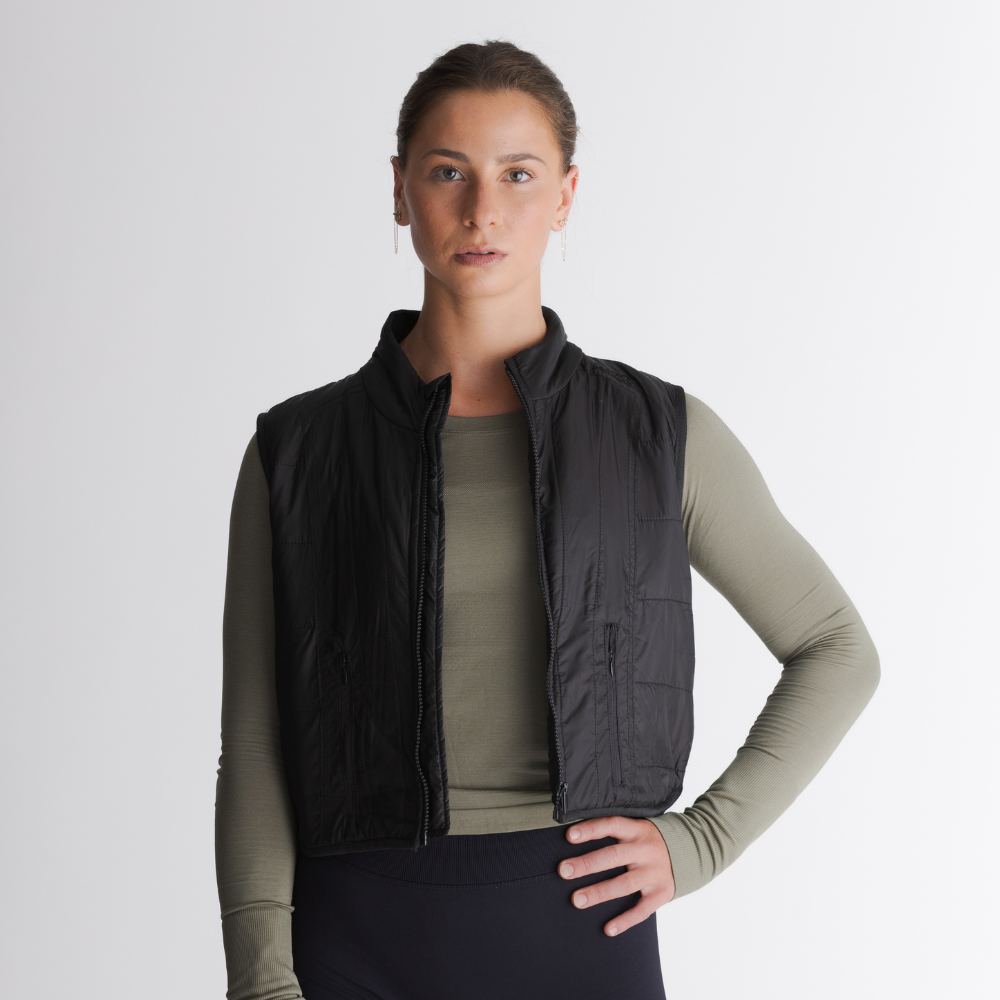
- The Women's Cropped Workout Vest: All the elite performance, compression, and stability of our full-length workout vest, engineered into a sleek cropped silhouette. This design allows for maximum core mobility, breathability, and comfort during your toughest, sweatiest sessions.
No extreme overhauls to your life. No complicated routines. Just strategic resistance added to the movements you are already doing.
Small, research-aligned changes compound over time. Science explains the “why.” Consistency delivers the results.


Menopause, Bone Density, and Weighted Vests FAQs
Are Weighted Vests Safe During Menopause?
Yes, provided you use them correctly. Safety depends on choosing the right weight and maintaining good posture. We recommend starting light (around 3-5% of your body weight) to allow your joints and connective tissues to adapt to the new mechanical load. If you have been diagnosed with advanced osteoporosis or have a history of spinal fractures, always consult your
Can a weighted vest replace weightlifting?
A weighted vest is a powerful complement to traditional resistance training, not a total replacement. While lifting dumbbells or barbells provides intense stimulus to isolated muscle groups, a weighted vest turns your cardiovascular exercise (like walking or hiking) into a load-bearing, bone-strengthening activity. For the best longevity outcomes, you should ideally incorporate both.
How often should I wear a weighted vest for bone health?
Consistency is key for triggering Wolff’s Law. Aim to wear your vest for at least 30 to 45 minutes during your walks, 3 to 4 times a week. Because the Aion Women's Lifestyle vest is sleek and comfortable, many women also wear it while working or running errands to accumulate more load-bearing time throughout the day.
Will a weighted vest hurt my neck and shoulders?
It shouldn't—if you are wearing the right vest. Cheap, unisex plate carriers hang the weight entirely from the shoulder straps, leading to upper trap tension and "tech neck." Aion vests are specifically engineered to distribute the weight 360 degrees around the torso, placing the load securely on your core and hips rather than dragging down your shoulders.
Disclaimer: Always consult a doctor before doing any type of exercise.


